
This article has been reviewed according to Science X's editorial process and policies . Editors have highlighted the following attributes while ensuring the content's credibility:
Credit: CC0 Public Domain
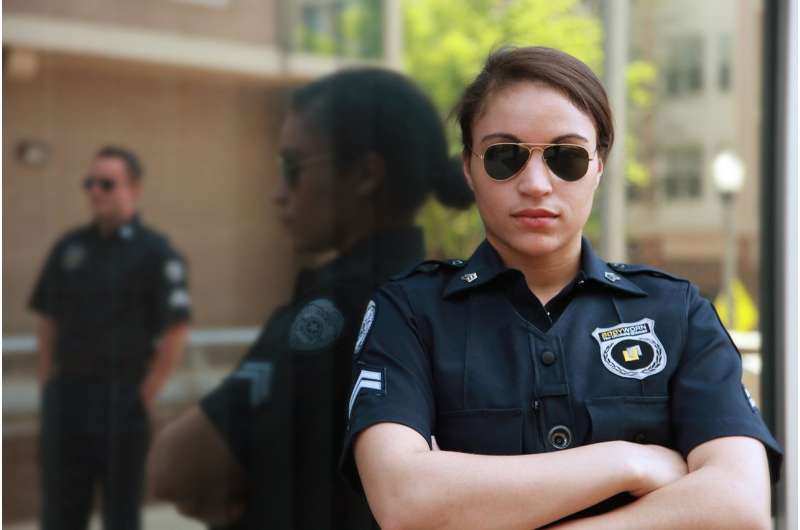
A field training officer is a special kind of cop. They have to be both patrol officer and mentor, as they teach recruits who are fresh out of the police academy how to put their lessons into practice. Much like mentors in other fields, these training officers (FTOs) hold a tremendous amount of responsibility. But that responsibility takes on more meaning given the nature of the job, and new research reinforces just how influential these guides are.
In a study recently published in the American Economic Review, researchers found that recruits who trained under FTOs who more often used force while on patrol also went on to be similarly forceful in their interactions on the job.
"The stuff that they're learning from their [FTO] during this period of time seems to have a really long-lasting impact on how these officers end up patrolling later," said Matthew Ross, an associate professor of public policy and economics at Northeastern University.
FTOs serve a vital function in police departments nationwide. In the police academy, a recruit learns through in-classroom training and simulations, but FTOs help provide real-world experience by going out on patrols or interacting with citizens. In addition to being patrol officers, they are also trained in how to teach and mentor young recruits. It's a demanding role that requires a "special kind of person," according to Betsy Smith, a spokesperson for the National Police Association and retired police sergeant with 29 years in law enforcement, including as an FTO.
"You've got to watch your recruit, but you also have to provide the public with the service that they need and they deserve," Smith said. "It's not the kind of job where you can go, 'Hold on, Mr. and Mrs. Jones. Stop fighting for one minute. I need to instruct my rookie.'"
In many agencies, serving as an FTO also helps enterprising officers move up the ranks, so officers often volunteer to be FTOs, Smith said. But widespread staffing shortages and high rates of turnover and burnout among police departments nationwide have forced some departments to actively recruit FTOs or even lower some of the qualifications for the position, according to Colby Dolly, National Policing Institute's director of science and innovation.
"Generally speaking, most agencies want the person to have been on a patrol for several years, ideally probably five to seven years," Dolly said, adding that that duration is now trending shorter.
Ross's study focused specifically on data pulled from the Dallas Police Department (DPD), and in his conversations with DPD members, it quickly became apparent to him how much of an impact this early training has on an officer's career in the long term. Ross spoke with 30-year veterans of the department who could still remember one-liners their FTO would toss out while on patrol.
Using data pulled from 3.9 million 911 calls made to DPD and on which they acted from 2013 to 2019, Ross's team linked phone call data to force reports, arrest records, Dallas County District Attorney records and reports of individual officer characteristics. The team also obtained detailed information on the dates of specific FTO assignments for each officer.
With all that data, they were able to identify pairings of recruits and FTOs for each field training phase over the six-year period. They then replicated the DPD's randomized approach to pairing FTOs and recruits and cycling recruits through various FTOs during separate field training phases to see what might happen if a recruit gets assigned to an FTO who tended to use higher levels of force, including the use of handcuffs, restraining a person or even firing a weapon.
Even a slightly higher propensity to use force among FTOs, like more frequent aggressive cuffing of suspects, can lead to a 14% to 18% increase in a recruit's use of force, according to Ross's findings.
Discover the latest in science, tech, and space with over 100,000 subscribers who rely on Phys.org for daily insights. Sign up for our free newsletter and get updates on breakthroughs, innovations, and research that matter—daily or weekly.
Recruits with more forceful FTOs also tended to use force more in cases that didn't involve an arrest and made more arrests for misdemeanors that didn't result in prosecution.
While FTOs also impart things like deescalation techniques and how to communicate peacefully with the public, the study indicates that "the more marginal types of force, which is probably the stuff we don't want happening, that seems to be transmitted from the FTO to the recruit," Ross said.
Notably, it was driven almost entirely by the first FTO they were assigned to, even as the recruits went on to work with other FTOs.
The impact of these early experiences was also persistent, and lasted for as far as Ross and his team could look in their data.
Even though the study looked at DPD, the use of FTOs across police academies in the U.S. is common, and so the paper's findings hold relevance beyond the Texas metropolitan area, Ross said. He also said that the paper's findings reveal that FTO programs could be a "particularly fruitful avenue" for reducing the use of force or making sure that it is applied correctly.
"There's a lot of opportunity to think about how we can redesign that and maybe even make it more effective or have it be effective in different dimensions," Ross said.
— Source: Phys.org (https://phys.org/news/2026-03-field-officer-habits.html)