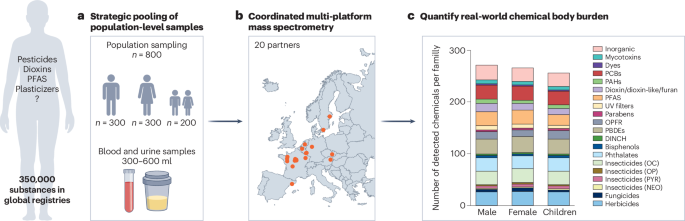
Pollution represents a silent global public health crisis, contributing to an estimated 9 million premature deaths annually1. It is likely that this figure underestimates the true burden, as only a fraction of the thousands of chemicals in global commerce have been adequately tested for safety or measured in humans, either individually or even more rarely as mixtures. Consequently, the cumulative health impacts of chemical exposures, including diseases, disorders and complex comorbidities, remain mostly unquantified and largely invisible1,2.
At the heart of this knowledge gap lies the ‘internal chemical exposome,’ defined as the totality of exogenous small molecules (<1,500 Da) and their biotransformation products (BTPs) present in human biospecimens3. These include hazardous chemicals originating from consumer products, diet, drugs, and diverse environmental and occupational exposures4. Despite mounting evidence linking chemical exposures to various health outcomes including developmental neurotoxicity, reproductive toxicity, carcinogenicity and immunotoxicity1, this dimension of human biology remains a blind spot in biomedical research2.
— Source: Nature Medicine (https://www.nature.com/articles/s41591-026-04289-7)